Cabaret is an intimate live entertainment format that combines music, storytelling, comedy, dance, theatrical performance, and direct audience connection.
Unlike traditional theater, cabaret is designed to feel personal. The audience is not separated from the performers by distance or formality. Instead, performers often speak directly to guests, share stories, improvise, and create a sense of shared experience.
Modern cabaret can include singers, dancers, burlesque performers, comedians, musicians, magicians, drag artists, immersive characters, and multidisciplinary entertainers.
Chicago has become one of America’s most vibrant cabaret cities, with a thriving ecosystem of theaters, nightlife venues, burlesque productions, immersive experiences, and independent artists creating unforgettable evenings of live entertainment.
Whether you’re planning a night out, exploring performance art, or looking for entertainment for a private event, understanding cabaret opens the door to an entire world of creativity, connection, and live performance.
Cabaret Definition
Cabaret is an intimate live entertainment format that combines performance, storytelling, music, and audience engagement in a shared social environment.
What Is a Cabaret Show?
A cabaret show is usually a live program presented in an intimate room where one or more performers may combine music, comedy, storytelling, drag, burlesque, dance, magic or other variety acts. The defining idea is the format and relationship with the audience—not one required performance style.
Cabaret as Performance Art
As a performance art, cabaret is defined by intimacy, personality, variety and direct audience connection. Its history stretches from late-nineteenth-century European artistic and satirical gatherings through supper clubs, jazz rooms and modern interdisciplinary nightlife. For the clearest comparison with burlesque, see Burlesque vs. Cabaret.
Defining Characteristics of Cabaret as Performance Art
- Intimacy: the audience is usually physically and emotionally closer to the performer than in a conventional large theater.
- Direct audience awareness: cabaret performers often acknowledge, address or respond to the people in the room rather than pretending they are invisible.
- Personality: the performer’s point of view, voice and relationship to the material are central to the experience.
- Variety: cabaret can combine music, comedy, storytelling, burlesque, drag, circus, dance, magic and other forms inside one evening.
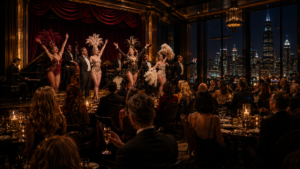
- A social room: the environment may include tables, drinks, dinner or conversation, making the setting part of the performance rather than a neutral container.
Those characteristics explain why cabaret can look very different from city to city while still feeling recognizably like cabaret. For the American version of that evolution, continue to Cabaret in America.
The word “cabaret” originated in France during the late nineteenth century.
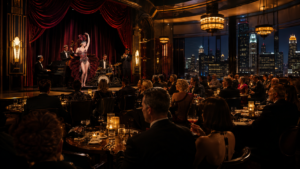
Unlike large theatrical productions, cabaret traditionally takes place in smaller venues where performers and audience members share the same space.
The emphasis is not simply on watching a performance.
The emphasis is on experiencing one.
Today, cabaret exists in many forms:
- Musical cabaret
- Burlesque cabaret
- Comedy cabaret
- Variety shows
- Speakeasy entertainment
- Immersive cabaret
- Dinner cabaret
- Drag cabaret
- Contemporary performance salons
At its core, cabaret is about human connection.
What Makes Cabaret Different?
Many people confuse cabaret with theater, burlesque, concerts, or variety shows.
While cabaret can contain elements of all these formats, it has its own identity.
Cabaret vs Traditional Theater
| Cabaret | Traditional Theater |
|---|---|
| Intimate environment | Larger audience separation |
| Direct audience interaction | Limited audience interaction |
| Flexible structure | Scripted structure |
| Often hosted or emceed | Usually narrative-driven |
| Social atmosphere | Audience primarily observes |
Traditional theater asks you to watch.
Cabaret invites you into the room.
Cabaret vs Burlesque
| Cabaret | Burlesque |
|---|---|
| Broad entertainment format | Specific performance art |
| May include music, comedy, storytelling, dance | May use striptease, character, theatricality, transformation, and audience engagement |
| A format or container for live entertainment | A distinct art form that can appear within cabaret |
Burlesque is a performance art. For the deeper definition of the form itself, read Red Hot Annie’s guide to What Is Burlesque?
Cabaret is an entertainment format.
A cabaret show may include burlesque acts, but not all cabaret is burlesque. For a clear side-by-side explanation, read Cabaret vs. Burlesque: What’s the Difference? →
To learn more, explore our guide to Chicago Burlesque Shows:
https://burlesque-chicago.com/burlesque-shows-chicago/
Cabaret vs Concerts
Concerts focus primarily on music.
Cabaret focuses on experience.
A cabaret evening may combine:
- live music
- dance
- comedy
- storytelling
- audience participation
- visual spectacle
- character-driven performance
The audience experiences a curated atmosphere rather than a single entertainment medium.
The Core Elements of Cabaret
While every production is different, most cabaret experiences include five foundational elements.
1. Intimacy
Cabaret thrives on proximity.
Guests feel connected to the performers and to one another.
This creates a sense of immediacy that larger productions often cannot replicate.
2. Personality
Cabaret performers bring their unique voice, humor, perspective, and character into the experience.
Authenticity matters.
The audience is not simply watching a role.
They are connecting with a person.
3. Variety
Cabaret rarely relies on a single performance style.
An evening may include:
- singing
- dancing
- burlesque
- spoken word
- comedy
- circus arts
- magic
- immersive storytelling
The variety keeps audiences engaged and surprised.
4. Atmosphere
Lighting, music, décor, costumes, and venue design all contribute to the experience.
The environment becomes part of the storytelling.
Atmosphere is one reason cabaret remains closely connected to nightlife culture.
5. Audience Connection
Audience engagement is one of cabaret’s defining features.
Performers often:
- acknowledge guests
- improvise
- invite participation
- respond to audience energy
- create moments unique to that evening
No two cabaret performances are ever exactly alike.

The Evolution of Modern Cabaret
Cabaret has evolved dramatically over the past century.
Early Cabaret
- Paris salons
- underground artistic gatherings
- political satire
- musical performance
Mid-Century Cabaret
- supper clubs
- jazz lounges
- singer-driven entertainment
- nightclub culture
Contemporary Cabaret
Today cabaret has expanded to include:
- immersive entertainment
- experiential nightlife
- burlesque revues
- themed events
- interactive performance
- luxury entertainment experiences
Many modern productions blur the boundaries between audience and performer.
This evolution has helped cabaret remain relevant in a world increasingly focused on experiences rather than passive consumption.
Why Chicago Has Become a Cabaret Destination
Chicago’s creative culture makes it uniquely suited to cabaret.
The city combines:
- world-class theater
- independent arts communities
- nightlife culture
- live music traditions
- experimental performance spaces
Neighborhoods such as:
- Logan Square
- Wicker Park
- Humboldt Park
- Uptown
- Andersonville
- The Loop
have helped cultivate a vibrant ecosystem of performers and venues.
Chicago is also one of the strongest cities in America for modern burlesque and immersive entertainment, making it a natural home for contemporary cabaret experiences.
Cabaret and Immersive Entertainment
One of the most important developments in modern performance is the rise of immersive entertainment.
Immersive entertainment differs from traditional performance because audiences actively participate in the experience.
Rather than simply watching a show, guests may:
- interact with characters
- explore environments
- influence outcomes
- discover hidden stories
- become part of the event itself
Many contemporary cabaret productions now incorporate immersive elements.
This is especially true within Chicago’s growing experiential entertainment scene.
Learn more about immersive nightlife and audience participation:
https://burlesque-chicago.com/immersive-theater-vs-immersive-entertainment/
Who Is Cabaret For?
Cabaret appeals to a surprisingly wide audience.
Date Night Seekers
Cabaret offers a memorable alternative to traditional dinner-and-a-movie outings.
Tourists
Visitors looking for authentic local culture often find cabaret experiences more memorable than mainstream attractions.
Arts Enthusiasts
Cabaret provides access to emerging artists and innovative performance styles.
Event Planners
Cabaret performers are increasingly booked for:
- galas
- fundraisers
- corporate events
- luxury parties
- brand activations
- private celebrations
Explore options for private event entertainment:
https://vaudezilla.com/hire-burlesque-dancers-chicago/
Frequently Asked Questions
What is cabaret entertainment?
Cabaret entertainment is a live performance format that combines music, storytelling, comedy, dance, and audience interaction in an intimate environment.
Is cabaret the same as burlesque?
No.
Burlesque is a specific performance art form.
Cabaret is a broader entertainment category that may include burlesque alongside music, comedy, theater, and other live performance styles.
Is cabaret interactive?
Often, yes.
Audience engagement is one of cabaret’s defining characteristics.
Many performers speak directly to guests or incorporate participation into the experience.
What should I wear to a cabaret show?
Dress codes vary by venue.
Many guests choose cocktail attire, vintage-inspired fashion, creative eveningwear, or stylish casual clothing.
Is cabaret appropriate for beginners?
Absolutely.
Cabaret is often one of the most accessible forms of live entertainment because it prioritizes connection, atmosphere, and enjoyment over specialized knowledge.
Where can I experience cabaret in Chicago?
Chicago offers a wide variety of cabaret experiences, including burlesque revues, immersive productions, live music performances, speakeasy events, and contemporary nightlife experiences.
The Future of Cabaret
As audiences increasingly seek meaningful experiences, cabaret continues to evolve.
People want more than entertainment.
They want participation.
Connection.
Atmosphere.
Story.
Memory.
Cabaret sits at the intersection of all four.
Its ability to adapt while preserving intimacy is why the art form has survived for more than a century—and why it continues to thrive in cities like Chicago.
What To Do Next
Ready to explore Chicago’s cabaret scene?
Looking for a live performance?
👉 Explore Chicago Burlesque Shows
https://burlesque-chicago.com/burlesque-shows-chicago/
Interested in performing?
👉 Discover Burlesque Classes in Chicago
https://burlesque-chicago.com/burlesque-classes-chicago/
Planning an event?
👉 Hire Burlesque & Cabaret Entertainment
https://vaudezilla.com/hire-burlesque-dancers-chicago/
Curious about immersive experiences?
👉 Enter The Pink Hotel
https://vaudezilla.com/pink-hotel/?utm_source=burlesque-chicago&utm_medium=referral&utm_campaign=what_is_cabaret&utm_content=immersive_example
Cabaret is not simply something you watch.
It’s something you step inside.
Cabaret is a format, not one fixed aesthetic.
The Pink Hotel shows how live performance, character and atmosphere can be shaped into a larger cabaret environment.