Chicago is remembering something it has always known:
a great night out should be more than a place to drink.
It might begin over dinner. A jazz trio starts playing. Curtains open. A cabaret performer appears a few feet from your table. The room gets darker, louder or stranger as the evening goes on. Maybe you planned to stay for ninety minutes and realize three hours have passed.
That experience is increasingly visible again across Chicago.
Supper clubs are turning dinner back into an evening. Cabaret is appearing in intimate rooms across the city. Historic speakeasy spaces are mixing serious cocktails with live performance. Burlesque, circus, comedy and immersive theater are crossing boundaries. New productions are being designed around the idea that the audience should feel somewhere, not simply watch something.
Call it experiential nightlife.
Or, perhaps, Chicago’s new Roaring Twenties.
If what you really want is a sophisticated evening of cabaret, cocktails and live entertainment, start with our guide to Chicago cabaret shows and supper clubs.
What Is Experiential Nightlife?
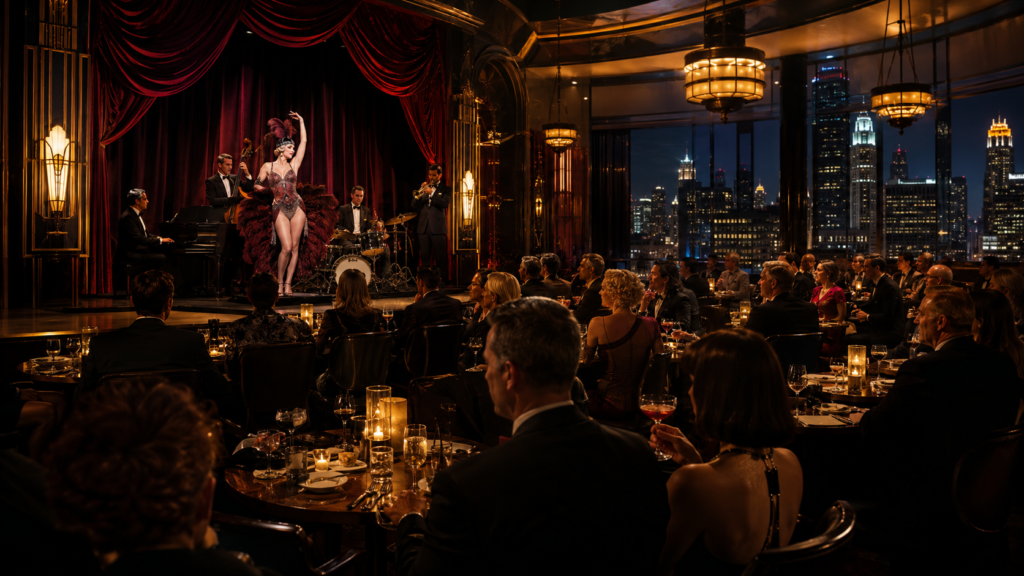
Experiential nightlife is a night out in which the atmosphere, entertainment and social experience matter as much as the drinks or destination itself.
That can include:
- dinner with live entertainment
- supper clubs
- intimate cabaret
- burlesque
- jazz and live music
- speakeasy-style rooms
- immersive theater
- circus and variety
- audience interaction
- theatrical dining
- hidden or highly designed environments
Some experiences are interactive.
Others are not.
That distinction is important.
You do not need to solve a mystery, speak to an actor or become part of the show for a night to feel experiential. Sometimes the experience comes from the room, the music, the proximity of live performance, the service, the audience and the way the evening unfolds.
The real difference is simple:
you remember the night, not merely the bar.
Why Chicago Feels Ready for Another Roaring Twenties
The comparison is imperfect, but the cultural impulse is recognizable.
The original 1920s followed years of enormous social disruption. Nightlife became a place for fashion, music, dancing, experimentation and social reinvention.
A century later, people have emerged from another period of isolation with a renewed appreciation for experiences that require actual presence.
Screens can deliver almost unlimited entertainment.
They cannot reproduce:
the sound of a live singer across a small room.
the moment an audience realizes something unexpected is about to happen.
the energy of a performer three feet from your table.
a cocktail arriving while a band changes tempo.
the feeling of entering somewhere that seems disconnected from the street outside.
That may explain part of the appeal of Chicago’s current supper-club, cabaret and experiential-nightlife revival.
The desire isn’t necessarily to recreate 1926.
It is to make 2026 worth going out for.
The Supper Club Is Becoming a Night Out Again
For years, dinner and nightlife often operated as separate activities.
Eat.
Pay.
Leave.
Go somewhere else.
The supper-club model asks you to stay.
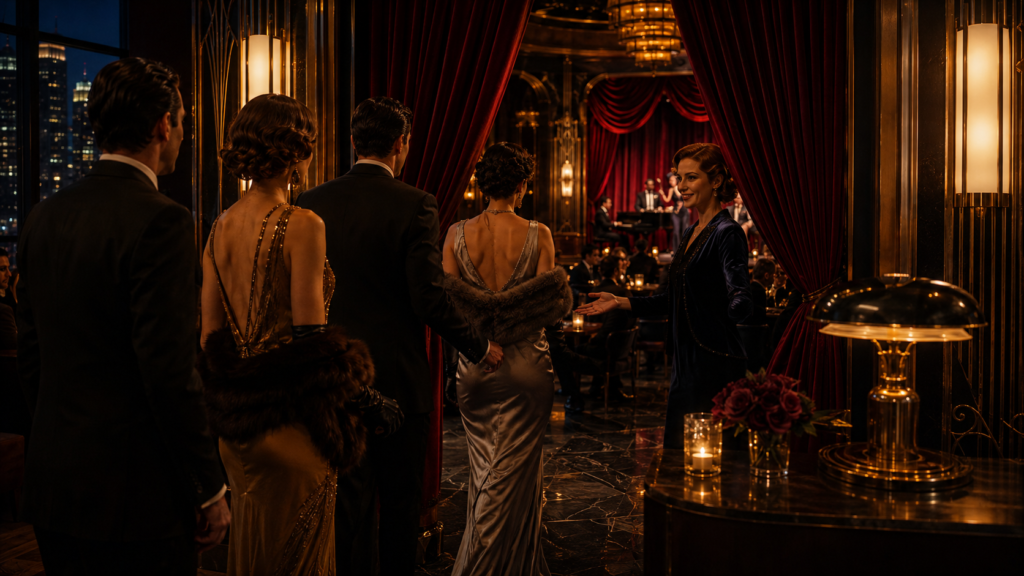
Chicago is seeing renewed interest in restaurants and entertainment rooms where dinner can gradually become drinks, music, performance and late-night socializing.
That makes places like Untitled Supper Club particularly relevant.
Its River North environment combines dining, cocktails and whiskey with live music and scheduled entertainment. Its weekly Unbridled production adds burlesque, aerial performance, vocals and variety to the supper-club format.
What makes that important is not simply that burlesque happens there.
It’s that performance belongs to the evening.
You aren’t choosing between dinner and a show.
The night contains both.
For more places built around that idea, explore Chicago cabaret shows, supper clubs and sophisticated live entertainment.
Cabaret Is Built for This Moment
Cabaret has always understood intimacy.
It does not require an arena.
Often it is better without one.
A singer, musician, comedian, burlesque performer or storyteller can change the energy of a room without the distance created by a conventional stage production.
Chicago still supports that kind of close-range performance.
The city’s contemporary cabaret ecosystem includes intimate music rooms, restaurants, theaters and special programs throughout Chicagoland. Chicago Cabaret Week has also grown into an annual citywide introduction to the form.
For someone who hasn’t experienced cabaret before, this can be one of the easiest ways into experiential nightlife.
Order a drink.
Sit close.
Pay attention.
The scale is part of the experience.
New to the form? Read What Is Cabaret?
Or, if you’re trying to decide what kind of show you actually want, compare cabaret and burlesque before choosing your night.
Speakeasies Work Best When They Offer More Than Décor
A hidden entrance and vintage wallpaper do not automatically create an experience.
The best speakeasy-style nightlife gives the room a reason to exist beyond aesthetics.
The Drifter is an especially useful Chicago example because the setting itself is genuinely historic.
Located beneath Green Door Tavern in a Prohibition-era space, the small room pairs an extensive rotating cocktail program with short live performances appearing throughout the evening.
The entertainment isn’t necessarily the entire reason to go.
That’s precisely what makes the format interesting.
You may be talking over cocktails when the room shifts and a performer appears.
Then the evening returns to itself.
It is a very different relationship between nightlife and performance than buying a theater ticket.
Bordel: When the Entire Room Becomes Part of the Show
Bordel offers another interpretation.
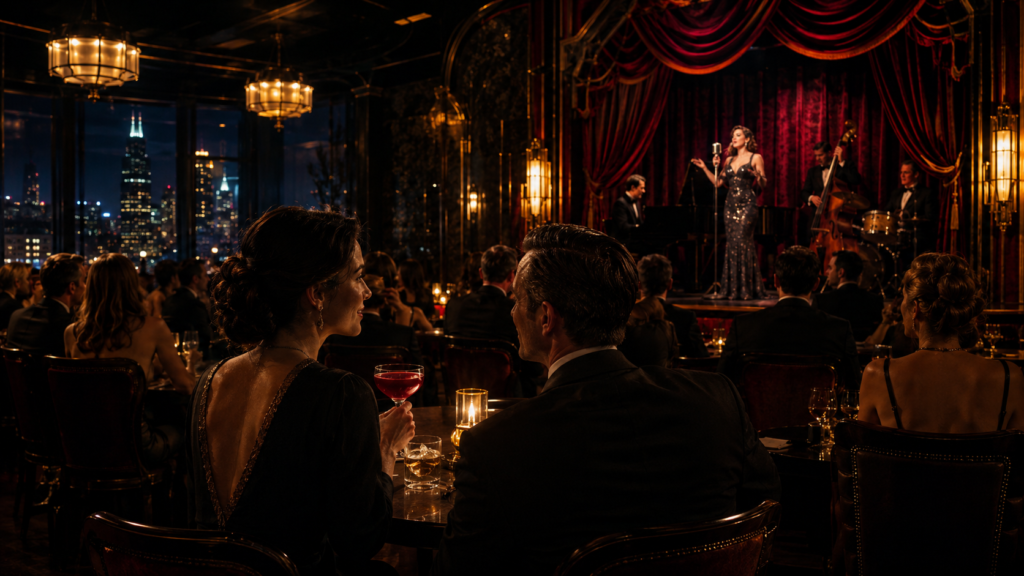
Its Wicker Park room is built around candlelight, velvet, cocktails and Parisian-inspired decadence, with current cabaret performances Thursday through Saturday.
Here, live performance is embedded into a larger social night involving cocktails, music and the room itself.
That makes it particularly appealing for a sophisticated date or smaller celebration where atmosphere matters as much as the individual acts.
It also illustrates an important distinction:
great experiential nightlife does not always require audience participation.
Sometimes being enveloped by the evening is enough.
The Next Evolution: Dinner Theater Gets More Immersive
One of the clearest signs of where this is heading arrives in Chicago this fall.
Opening in October 2026, Premonitions Inc. at Kermess is scheduled to combine dinner-theater storytelling with aerialists, acrobatics, burlesque, cabaret, comedy and audience games inside a century-old Belgian Spiegeltent fourteen floors above Randolph Street.
That combination is revealing.
Restaurant.
Cocktails.
Story.
Design.
Circus.
Burlesque.
Comedy.
Participation.
Instead of forcing audiences to choose among categories, the experience uses several at once.
That may be one of the defining characteristics of the next generation of Chicago nightlife.
The boundaries matter less than whether the evening is worth leaving the house for.
Burlesque Fits Naturally Into Experience-Driven Nightlife
Burlesque works particularly well in these environments because it thrives on proximity.
A great burlesque act isn’t simply choreography viewed from a distance.
It plays with attention.
Anticipation.
Humor.
Timing.
Eye contact.
Reveal.
The relationship between the performer and the room matters.
That’s one reason burlesque works so differently inside an intimate cabaret or supper club than it does in a large conventional theater.
The setting changes the experience.
If burlesque specifically is what brought you here, skip directly to our current guide to the best burlesque shows in Chicago.
What Makes an Experiential Night Actually Good?
A room does not become “immersive” because somebody uses the word in the marketing.
And expensive does not automatically mean sophisticated.
The strongest experiences tend to get several things right.
The room has a point of view
Lighting, architecture, sound, seating and service work together.
You understand how the night is supposed to feel before anyone explains it.
The entertainment belongs there
A singer shouldn’t feel dropped into a restaurant corner because management decided live music was fashionable.
The performance should make sense in the room.
Something unfolds
Great evenings have rhythm.
Arrival.
Anticipation.
Dinner.
Performance.
A surprise.
A shift in energy.
Another drink.
A reason to stay.
It works socially
People can still talk.
Look around.
Meet someone.
Watch.
Participate if invited.
A sophisticated experiential night does not require guests to perform enthusiasm on command.
It gives you something you could not get at home
This is the ultimate test.
If the entire experience could be reproduced by streaming something while ordering dinner, there was little reason to go.
Live entertainment should reward presence.
How to Choose the Right Experience
Don’t start by asking:
“What’s the best nightlife in Chicago?”
Ask what you actually want from the evening.
You want dinner, drinks and entertainment in one place
Choose a supper-club experience.
You want something intimate and romantic
Look for cabaret, jazz or a small speakeasy-style room.
You specifically want glamour, tease and theatrical performance
Choose burlesque.
You want the evening to revolve around a story
Choose immersive theater or theatrical dining.
You want surprise without committing to a formal show
Choose a room where live entertainment appears throughout the night.
You’re celebrating
Think beyond the show itself.
Where will you eat?
Can your group sit together?
Can you hear each other?
Does the venue take reservations?
Does the energy fit the occasion?
For birthdays, bachelorette weekends and private groups, explore Chicago celebration and bachelorette experiences.
Chicago Nightlife Is Becoming More Layered
The interesting development isn’t that bars are disappearing.
They aren’t.
It is that the line between restaurant, theater, cocktail lounge, cabaret and event is becoming less useful.
A sophisticated night might contain pieces of all of them.
That reflects something Chicago has done for generations.
Live music has shared space with food and drink.
Cabaret has blurred theater and nightlife.
Burlesque has mixed spectacle, comedy and audience connection.
Supper clubs have made lingering part of the point.
What’s changing now is the expectation that the entire evening can be designed as an experience.
That gives guests more interesting choices.
It also raises the standard.
A feather boa and an antique lamp are no longer enough.
Want Someone Else to Create the Room?
There is another kind of visitor who finds pages like this.
You’re not trying to decide where to go.
You’re planning the night yourself.
A corporate gala.
A milestone birthday.
A client dinner.
A private celebration.
A hospitality event.
A Roaring Twenties party that you desperately do not want to feel like a costume-store theme night.
That is where the conversation changes from editorial discovery to production.
The goal isn’t simply to place performers in a room.
It is to determine what kind of entertainment belongs with the audience, venue, timing and atmosphere you are trying to create.
If burlesque specifically is part of the plan, explore professional burlesque entertainment through Vaudezilla.
Want to Try Burlesque Yourself?
For some people, the best night out creates a different thought:
I want to try this.
Not become a performer.
Not build an act.
Just experience the movement, glamour and playfulness from the other side.
For beginner-friendly classes and private group experiences, see current Chicago burlesque classes with Red Hot Annie.
It can be a class.
A celebration.
A private group experience.
Or simply something unusual to do in Chicago.
The New Roaring Twenties Don’t Need to Look Like the Old Ones
Chicago doesn’t need another decade of Gatsby costumes.
The most interesting revival is not visual.
It’s behavioral.
Go somewhere beautiful.
Dress a little better because the room deserves it.
Eat slowly.
Listen to live music.
Watch something happen in real time.
Talk to the person beside you.
Stay longer than you planned.
Have a night that doesn’t collapse into content the next morning.
That may be the real promise of experiential nightlife.
Not escaping into the past.
Remembering that going out can still feel like an event.
Find sophisticated Chicago cabaret shows and supper clubs →
Compare the best current Chicago burlesque shows →
And if you’re planning the room instead of attending it, explore custom live entertainment through Vaudezilla →.