A burlesque costume is seen from farther away, in stranger light, while the body is moving. That changes what “beautiful” means. Texture has to survive distance. Shape has to read in motion. Reflective materials can become part of the lighting design. Feathers can turn a small gesture into a large moving field.
Stage distance changes the costume
A detail that looks extraordinary from twelve inches away can disappear from twenty feet away. Conversely, something that feels exaggerated in a dressing room may become perfectly legible from the back of the audience.
This is one reason stage costume has its own visual logic. The V&A’s Theatre & Performance collection preserves thousands of stage costumes and accessories across theatre, dance, music hall, cabaret and circus. They are designed for performance conditions, not simply for static viewing.
Feathers amplify movement
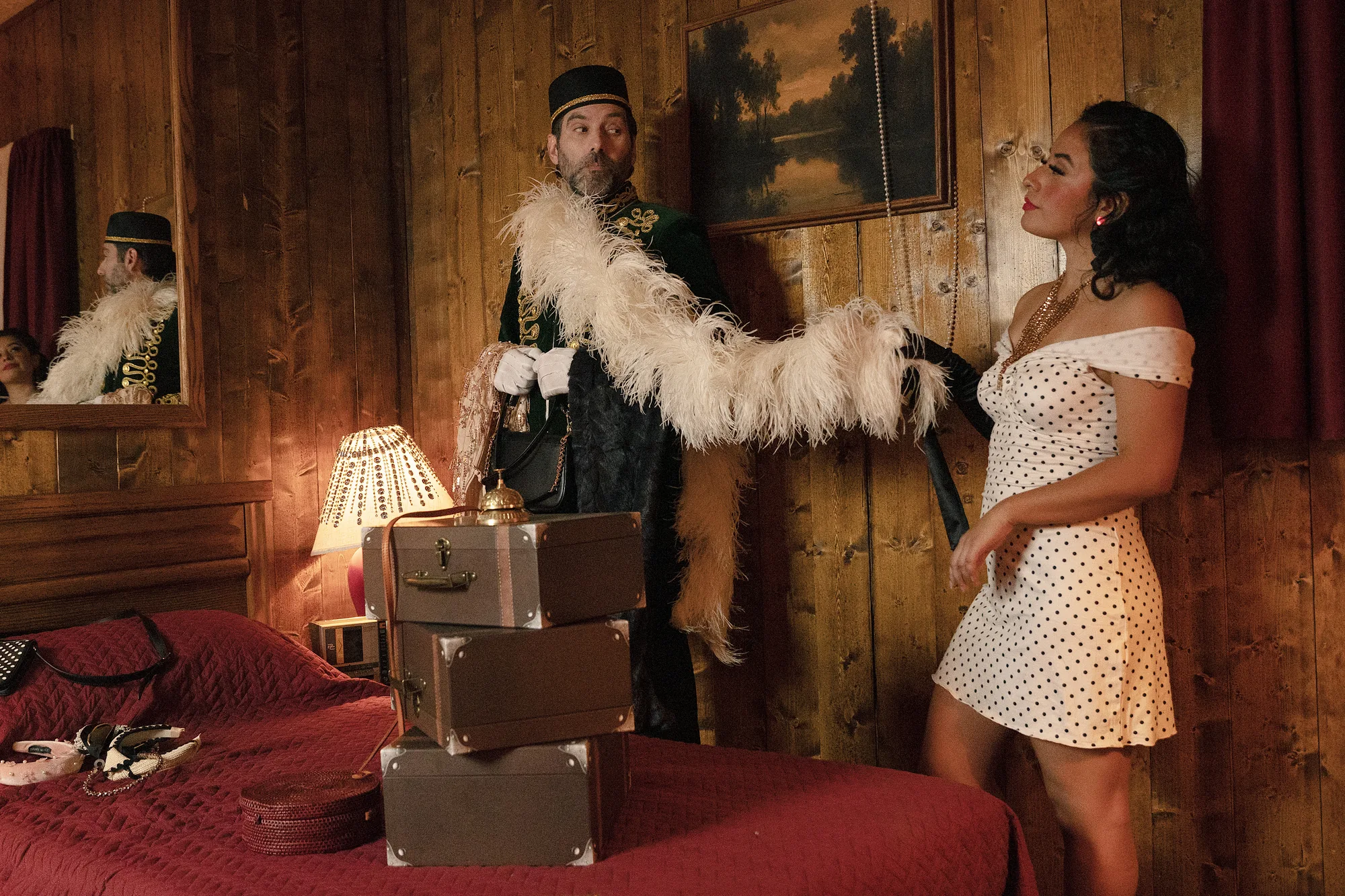
Feathers do something fabric cannot do in exactly the same way: they continue moving after the body has initiated the gesture. A fan sweeps, flexes and settles. A boa drags behind a turn. A feathered headdress changes shape as the performer changes angle.
That delay creates visual volume. It makes movement easier to see from a distance because the costume leaves a larger trace in space.
For the performance logic of the prop itself, read Feather Fan Dancing in Burlesque.
Rhinestones turn light into motion
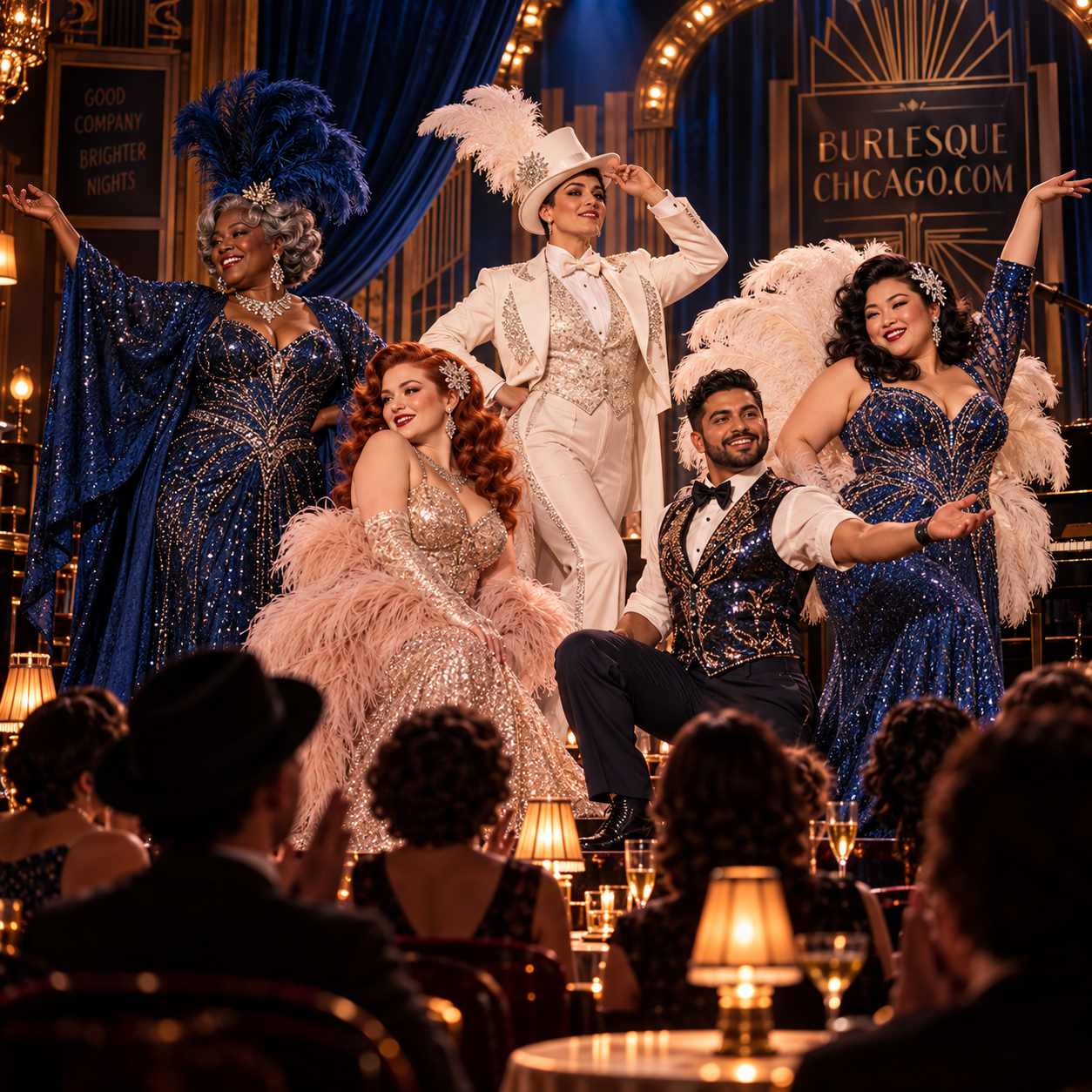
Rhinestones, sequins, crystals and metallic trims do not simply add “sparkle.” Their visual effect changes as the performer and lighting angle change. A static costume may show a few bright points; the same costume in motion can produce a field of changing highlights.
That is why reflective embellishment often becomes more legible under theatrical light than it is under ordinary room light. The material helps turn movement into flashes, edges and accents that the audience can read across a larger space.
Lighting changes color and texture
Theatrical designers do not treat costume and light as separate worlds. The Library of Congress describes theatrical design as a coordinated system of scenery, costumes, lighting and effects. Onstage, color is always being filtered through the lighting environment.
A pale costume can become cool, warm or nearly monochrome under different cues. Black can disappear into a dark background or create a sharp graphic shape under a brighter edge light. Highly reflective details can catch a beam while matte fabric absorbs it.
This is why costume choices should be tested in the light the audience will actually see—not only under dressing-room mirrors.
Silhouette usually reads before detail
From a distance, the audience often reads the outline first: wide shoulders, long gloves, a giant fan, a narrow corseted waist, a train, a high headpiece, a circle skirt, bare legs, a cape.
That makes silhouette one of the fastest ways to establish character. A costume can tell the audience “showgirl,” “authority,” “bird,” “monster,” “bride,” “ringmaster” or “something is wrong here” before the performer has completed a single gesture.
More embellishment is not always more visible
Stage scale can tempt performers to keep adding detail, but visual density has a limit. If every surface has the same amount of shine, fringe, texture and color, the costume can lose hierarchy. The eye has nowhere to land.
Strong costume design often creates contrast: matte next to reflective, fitted next to voluminous, dark next to bright, still next to moving. That contrast makes individual elements easier to read.
The costume has to survive motion
Stage costume is not sculpture. It has to move, flex, turn, release and sometimes come apart on cue. The V&A’s costume material repeatedly treats performance costume as a working object, not merely a decorative artifact. That is one reason surviving stage costumes are so useful to performance history: wear, construction and alteration can reveal how the object was actually used.
For burlesque, that practical truth is especially important because so many costume elements become part of choreography. A fan, glove, stocking, train or skirt is not finished when it photographs well; it has to behave reliably in motion.
Why this matters for the audience
The audience does not experience “the costume” separately from the performer. It experiences a changing picture: body, fabric, light, movement, sound and reveal arriving together.
That is why burlesque costume can feel excessive in the best sense. It is built for transformation and visual communication. The feathers are not only feathers. The rhinestones are not only rhinestones. They are tools for scale, rhythm, focus and spectacle.
Keep exploring the stagecraft
Use The Stagecraft Desk as the department index for the full visual-performance shelf.
Continue with Costume Reveal as Stagecraft, Tease and Reveal, Stage Presence and the practical Costumes, Props & Stagewear guide. The Burlesque Encyclopedia defines related terms such as peel, reveal, fan dance and tassel twirling.